
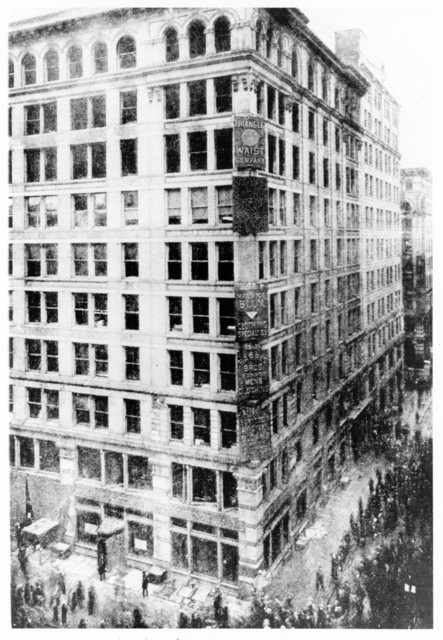
“Made in the U.S.A.” hasn't always carried the badge of honor and quality it does today. The early years of American manufacturing, stretching from the 1700s through the early 1900s, were marked by horrific working conditions, worker exploitation, and tragic loss of life. Among the most infamous examples was the Triangle Shirtwaist Factory fire.
We observe Labor Day to recognize the efforts and perseverance of people who grew tired of abuse and demanded safer, more humane working conditions. What resonates with us at Ragged Mountain Equipment is that the textile and garment industries were just as guilty as coal mines, steel mills, railroads, meatpacking plants, lumber mills, and food-processing facilities when it came to dangerous and often intolerable workplaces.
Ragged Mountain Equipment is a proud retailer of exceptional outdoor gear, but at our core, we are a clothing brand and local manufacturer. Our Ragged Mountain-branded apparel and gear are made right here in our shop in Intervale, New Hampshire, just as they have been for more than forty years. We're one of thousands of American businesses that began with a dream and grew through hard work and determination, following a tradition that dates back to the nation's earliest textile mills. In 1793, Slater Mill opened in Pawtucket, Rhode Island, helping launch America's mechanized textile industry.
Back then, the clothes you wore were typically made at home, by a family member, or by a local tailor, depending on your means. Clothing production was a highly skilled, labor-intensive craft that required time and expertise. Garments were certainly not considered disposable, as many inexpensive clothing items are today. They were repaired repeatedly and worn for years. Even when a piece of clothing seemed beyond saving, someone often found a way to get one more repair out of it.
Garment-making was such a fundamental part of everyday life that many textile-inspired expressions remain common today. We say someone is "cut from the same cloth" or that a person is "hanging on by a thread." Being called part of the "fabric of society" is a compliment. And after a big Thanksgiving dinner, someone may joke that they're "bursting at the seams."
Everything changed after Elias Howe patented the lockstitch sewing machine in 1846. Sewing technology helped make mass production of ready-to-wear clothing possible, and by the 1850s and 1860s, industrialization was in full swing. Unfortunately, it also ushered in many of the abuses and unsafe conditions that workers endured simply to earn a living. Garment and textile workers were often immigrants, women, and young people, much like those employed at New York City's Triangle Shirtwaist Factory.
The company employed between 500 and 600 workers and occupied the eighth, ninth, and tenth floors of the Asch Building at the corner of Washington Place and Greene Street in Greenwich Village. Conditions were crowded, noisy, hot, and, as the world would soon discover, filled with highly flammable materials. Wages were low, typically between $7 and $12 per week for 50 to 60 hours of grueling, repetitive labor. Managers, under the direction of the owners, also locked exit doors to discourage unauthorized breaks and prevent theft.
When a fire broke out in the building on Saturday, March 25, 1911, at approximately 4:45 p.m., 146 workers were killed, including 123 women and 23 men. Many were trapped behind locked exit doors on the eighth, ninth, and tenth floors. Owners Max Blanck and Isaac Harris were charged with first- and second-degree manslaughter but were acquitted after just two hours of jury deliberation. The defense successfully argued that there was no proof the owners knew the doors were locked at the time of the fire. Both men soon opened new garment factories under different names. In 1913, Blanck was once again caught locking a factory door during working hours and was fined just $20.
It's worth noting that this tragedy occurred after the labor movement had already begun gaining momentum. The first Labor Day parade took place in New York City on September 5, 1882, when 10,000 workers marched through the city under the leadership of New York's Central Labor Union. Labor Day became a federal holiday in 1894.
So rather than simply celebrating Labor Day, we view it as an opportunity to honor the long and difficult struggle of those who fought for safe working conditions for everyone, regardless of occupation or industry. We also remember the lives lost in tragedies such as the Triangle Shirtwaist Factory fire, whose sacrifices helped make those changes possible.